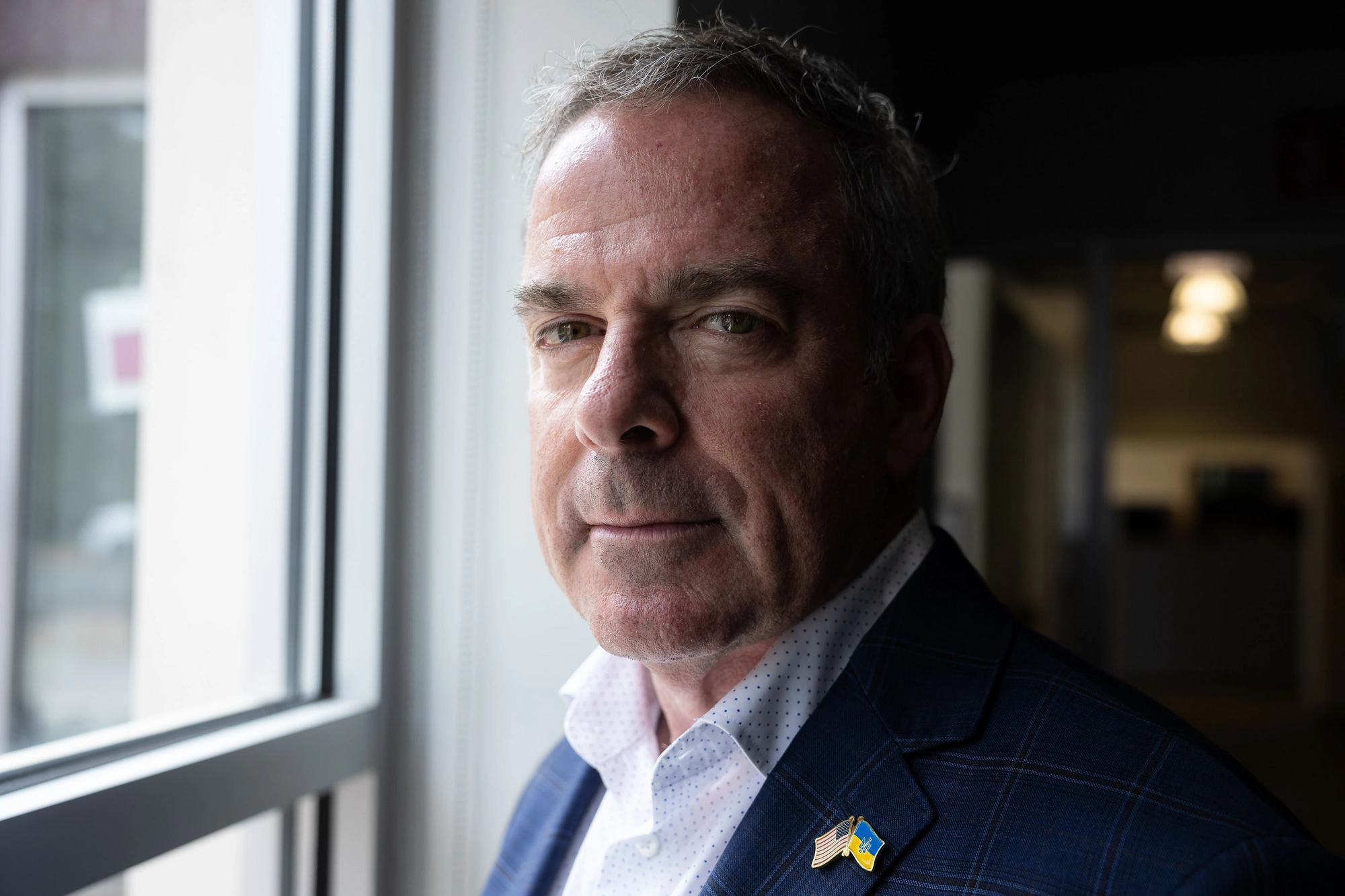
Last summer, we traveled to Sloviansk, a free city in the Donetsk Oblast of eastern Ukraine. There we met Oleksandr Pavenko, the pastor of the Transfiguration of the Lord Pentecostal Church. This church is special for a number of reasons. The building once served as a center for atheistic Soviet “Ministry of Culture” and currently functions as one of the largest aid centers in the region, providing food, water, and clothing for the needy throughout the entire city. It is near where in 2014, members of the “Russian Orthodox Army” kidnapped Pastor Pavenko’s two sons and brutally tortured them before murdering them and burning their bodies—all for being evangelical Christians opposed to, or even just insufficiently supportive of, the Russification of western Ukraine.
That church now sits at the center of a debate unfolding far from Sloviansk. As negotiations proceed to end Russia’s war, some argue that Ukraine should cede all of Donetsk to Moscow, including this city, despite Russia’s inability to seize the region militarily after years of fighting.
Under this scenario, Sloviansk would be subject to Russia’s “Yarovaya” law, which forbids publicly preaching the Gospel inside Russian territory unless part of the state sanctioned Russian Orthodox Church. As we document in A Faith Under Siege, Putin’s forces have seized and shuttered evangelical churches throughout Ukraine. Pastor Pavenko’s church would suffer the same fate. He and his fellow church leaders would become marked men, perhaps joining the dozens of other pastors and priests murdered by Russia during their invasion. While Putin has engaged in a far-too successful propaganda campaign against wherein he casts himself as the defender of Christendom against a decadent West, the truth is that he has a completely amoral, utilitarian approach to religion: it is good when it serves him, bad when it doesn’t.
We applaud the Trump administration’s push to find a durable end to the Russo-Ukrainian conflict. President Trump has stated that he wants his legacy to be as a peacemaker, a goal consistent with America’s moral and strategic interests. But peace is not achieved by redrawing borders in ways that reward Putin’s aggression or by consigning religious communities to repression.
The loss of the Donetsk region to Russia is not a foregone conclusion. Since the beginning of 2025, Russian forces have made only limited territorial gains in eastern Ukraine, often measured in hundreds of meters rather than kilometers, despite committing substantial manpower and artillery. Western and Ukrainian estimates consistently place Russian losses since the full-scale invasion in the high hundreds of thousands killed and wounded, with particularly heavy attrition in Donetsk. No wonder Putin is pushing so hard to grab this “fortress belt” by diplomatic means after continuing to fail using force.
Forcing Ukraine to cede territory would not only endanger millions, but it is directly contradictory to the advancement of international religious freedom, one of President Trump’s core foreign policy principles.
During his first term, he issued an Executive Order on Advancing International Religious Freedom, making the protection of believers a central aspect of U.S. foreign policy. He has continued to elevate this priority in his second term, most notably in Nigeria, where U.S. counterterrorism action and State Department pressure have been utilized in response to Islamist violence targeting Christian populations.
The Ukraine negotiations can build on that same principle: that America stands for peace through strength, and that the freedom to exercise one’s faith without fear is absolutely essential to any conceivable peace settlement. Supporting a just and lasting peace in Ukraine not only defends a democracy and contain an adversary—it also protects the right of millions of Christians to worship freely in their own homeland.
President Trump is the only one who can deliver something truly historic: ending the war and preserving the freedom of millions. He can strengthen his legacy as a champion for global religious freedom and as a peacemaker.
But a peace that leaves Christians behind would be a peace in name only, while violent injustice continues to proliferate behind a new Iron Curtain. Pastor Pavenko, who recently lost yet another son to the Russians, knows what awaits him and his church if the Russians return. When we spoke to Pavenko recently about when he would consider leaving, he said that he asked the Ukrainian soldiers defending Sloviansk the same thing. They told him, “we stay as long as the church stays, we leave together.”
President Trump should insist on a settlement that requires no one to leave and no churches to close. The only way to ensure a peace that lasts is an end to the war that ensures that believers across Ukraine are not doomed to dark and faithless days under Russian occupation.