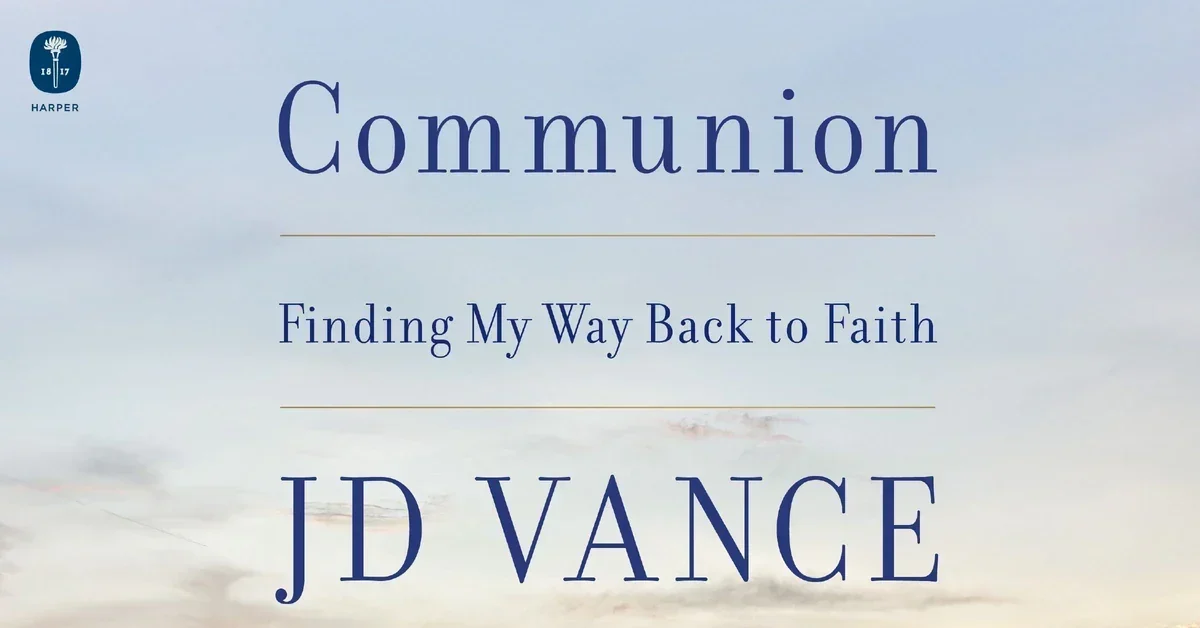
I have always wanted to like J.D. Vance. He is smart, accomplished, and shares my Catholic faith as well as many of my socially conservative convictions. Nonetheless, I have time and again been disappointed by his words and actions as a politician, particularly regarding his stance on Ukraine. Yet despite my issues with Vance, I was eager to read his book—not to confirm my opinion of Vance, but to answer my own questions. How could a man who has written so movingly of his own Christian conversion behave, at times, so uncharitably? Ultimately, the book did not give me easy answers, but it did give me something else: hope.
As literature, Communion is excellent. Vance writes eloquently of his journey from the non-denominational evangelical Christianity of his youth to the atheism of his young adulthood and, finally, to his conversion to Catholicism in 2019. While some have billed the book as a pre-campaign memoir, it didn’t strike me that way. (The one exception comes near the end of the book, where his digressions into the policies of the Trump administration seemed out of place and more at home in a political campaign.) Vance began writing Communion in 2019, long before a presidential campaign was on the horizon, and he seems sincere in his hope that “by sharing my journey I might be helpful to others…seeking reconciliation with God.” Vance writes compellingly of his desire to be a good husband and father and to develop the virtues he hopes to instill in his children—a desire that ultimately led him back to the Christian faith. Vance is humble about his shortcomings, past and present. He comes across as committed to his faith, his family, and his country (in that order). It’s hard for me to see how a reader with no prior knowledge of Vance could fail to be moved by his story of despair and redemption.
And yet, I struggled to relate the Vance of Communion to the Vance of Donald Trump’s White House. Repeatedly, I was struck by their incongruity. Vance writes of the importance of interracial harmony, yet spread discredited rumors about Haitian immigrants in Ohio eating pets to drum up support for the Trump campaign. Vance writes that his “basic view is that too many American Catholics treat the Pope as a political figure and should instead keep a more respectful distance from Vatican politics”; nonetheless, he played right into the Trump vs. Pope Leo narrative earlier this year by saying, “…it would be best for the Vatican to stick to matters of morality, to stick to matters of what’s going on in the Catholic Church and let the president of the United States stick to dictating American public policy.” Vance writes repeatedly about the importance of Christian virtue, yet he has tethered his political career to a serial adulterer who calls his adversaries nasty names and posted an image of himself as Jesus. The list goes on.
This contrast between the humility and nuance of Vance-as-author and Vance-as-politician often felt inescapable. He does note that the Christian faith teaches statesmen that “it’s ok to admit error” and apologizes for his infamous “childless cat lady” remark. So, perhaps he has learned to moderate his rhetoric over time. Nonetheless, his social media posts and public remarks are often bombastic and suggest an inflexible, ideological mentality.
A good example of this is the section on international affairs and Ukraine. In late 2024, I wrote for this publication criticizing Vance’s stance on Ukraine, and particularly his lack of moral support for Ukrainians. In 2022, Vance even stated: “I don’t really care what happens to Ukraine one way or another.” In reading Communion, I was therefore surprised when Vance stated that Russia should not have invaded and expressed sympathy for a Ukrainian parliamentarian he met in Munich. In April 2024, Vance wrote an op-ed for The New York Times stating that he remained “opposed to virtually any proposal for the United States to continue funding this war.” In his book, however, Vance describes his view at the 2024 Munich Security Conference (just two months before the NYT op-ed) a bit differently:
“The United States has money…but the gap between Ukraine’s and Russia’s abilities to project military power was vast, and we lacked the capacity to enable the Ukrainians to close that gap—and keep it closed—all by ourselves. The United States needed Europe to step up. And so long as that gap remained, there was nothing wrong in promoting a negotiation to end the conflict.”
Vance goes on to explain that the Munich Conference changed his mind “about the character of the people driving these foreign policy decisions.” He came to see that the “men and women who had built the ‘US-led world order’ were…well-intentioned,” more tragic figures whose life’s work had failed than “evil globalists.”
Had Vance expressed himself in this more measured, nuanced way at the time, I would still have disagreed with elements of his Ukraine policy, but I would have had far more respect for him. Vance is clearly capable of being reasonable and empathetic. This raises the question: if Communion accurately describes his thoughts and motivations, why has Vance painted such a different picture of himself through his public words and actions? Many people see this dissonance and conclude that Vance is simply a hypocrite, preaching Christian values for the sake of political power while behaving according to Machiavellian logic. I find that explanation unconvincing, though.
I think the key to understanding Vance is contained in the Christian faith he has (re-)embraced. Discussing his late friend Charlie Kirk, Vance writes, “Charlie contained multitudes… At his best, he shined as an example of Christian charity. At his worst, he was a sinner, like all of us.” The same could be said of Vance. I don’t think there are two J.D. Vances, one real and one fake. I think there is one J.D. Vance, highly flawed, often blind to his own failings, but also sincere in his love of God, family, and country. Even so, I worry that by tethering his career to President Trump and the MAGA movement, he has made it far harder to practice the kind of humble, virtuous Christian leadership he so admires.
In his Epilogue, Vance writes, “…’optimism’—a sort of blind faith that things will be better in the future—is misguided…[but] [h]ope is the antidote to despair, and one of the fundamental Christian virtues.” I am not one for optimism about Vance’s future, nor for that of our country. Nonetheless, Communion left me with hope. Vance will likely remain an influential leader in our country for years to come, and as long as he remains receptive to God’s grace in his life, there is a chance he will succeed in putting both himself and our nation on the right path. For his sake and the sake of our country, I will hope and pray for that.