Public Christianity means working to rebuild and renew public mores founded on a Christian philosophy of societal order and cohesion. It informs actions with the goal of creating a public sphere capacious enough to handle pluralism, but robust enough to act as one dominant culture. Public Christianity will open the political sphere “to glimpse something higher than itself,” to co-opt a phrase from theologian Russell Hittinger.
The thing about Christianity and why only it can fit the role of being a regulating principle in the American political and public realm, is that it does not abolish or undermine the natural human quest for first truths.
The nihilistic philosophies of our age are spiritually suffocating, especially the nonreligious, leading them into a “moralism which ends up in terrorism.” (Observe what our Jewish brethren are suffering around the world under the threat of anti-Semitism.) One of the principal goals of Public Christianity is to create an atmosphere where people can act upon their natural quest for wisdom, while preserving the public square from extremist ideologies and terror movements.
Public Christianity does not mean everyone has to become a Christian or go to church. Tocqueville writes:
If it serves man very much as an individual that his religion be true, this is not so for society. Society has nothing to fear nor to hope from the other life, and what is most important to it is not so much that all citizens profess the true religion but that they profess a religion.
Several points about this. First and foremost, as a devout Catholic Christian, I am not saying that I do not care about true conversion—absolutely I do. Religious conversion, however, happens through energetic evangelical efforts via horizontal relationships. These flow from connections made through voluntary associations; they also rely on the power and beauty of witnesses. Public Christianity will not take care of an individual’s personal relationship with God, but it will set a limit to the corruption of public virtue and by doing so save our public life together. Public Christianity is not so much about saving souls as preserving a minimum shared moral grammar.
Politics is indeed downstream from culture, but culture is influenced by politics as well. Bearing this in mind, it’s wrong to believe that Christians should not attempt to shift the culture through political means. In his book, The First Thousand Years: A Global History of Christianity, Robert Louis Wilken writes, “Religion was not a private affair, and moderns forget that in ancient times the world was ruled by emperors and kings. There was no future for Christianity that did not include the blessing of temporal rulers.”
Public Christianity is not the same as a religious revival, although it may play some role. For that reason, some Christians may find the concept of public, cultural Christianity obnoxious or offensive to authentic religious belief. They shouldn’t. The moral effectiveness of religion in and of itself is without question (religion regulates mores); by creating a public sphere where God is invoked without fear, where faith can be expressed without self-censure, where faith can make contact with reason and illuminate it, where Christian principles inform the public sphere and virtue develops once more, all these together create a synergy in the public life of our nation that can bring healing to our agonized culture, so that man can once again rise above his appetitive nature.
Doing so is the action of loving the world more than oneself, not doing so “robs the other of the opportunity to change.”
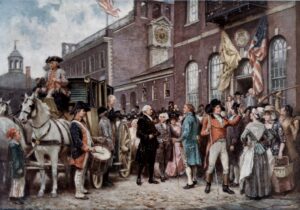
The Christian religion—particularly Protestantism—from the beginning of the American republic was public and influential. Public Christianity first of all uses Christian ethics and anthropology as the regulating principle for governing and law making. An example would be the way Christianity informed the Founders in the beginning of our republic—and we know for a fact that they were not all believing Christians.
In his proclamation that set Thursday May 3, 1984 as the National Day of Prayer, President Ronald Reagan quoted Benjamin Franklin’s speech to George Washington at the constitutional convention: “I have lived, sir, a long time, and the longer I live the more convincing proofs I see of this truth, that God governs in the affairs of men. And if a sparrow cannot fall to the ground without his notice, is it probable that an empire can rise without his aid?” “With these words,” President Reagan wrote, “Mr. Franklin called upon the Convention to open each day with prayer, and from the birth of our Republic, prayer has been vital to the whole fabric of American life.”
On September 3rd, Virginia Senator Tim Kaine had said in a senate hearing that he finds it “very very troubling” to hear that our human rights come from our Creator rather than our laws or our government. This kind of muddled thinking from a sitting senator is itself troubling, for many reasons, one of which is the breakdown in the understanding of basic civics. In response to Senator Kaine during his remarks to the White House Religious Liberty Commission, President Trump said, “everyone in this room understands, it is tyrants who are denying our rights and the rights that come from God. And it’s this Declaration of Independence that proclaims we’re endowed by our creator with the right to life, liberty and the pursuit of happiness.” Again he says, “We have to bring back religion in America.”
President Trump has invited faith communities across our land to pray for our country and our fellow citizens as part of the year-long preparation for the celebration of America’s 250th birthday. He also said that, “the Department of Education will soon issue new guidance protecting the right to prayer in public schools.”
A good many members of the current administration were present at Charlie Kirk’s memorial service; many gave testimony to their Christian faith, including Vice President J.D. Vance, a Catholic, and Secretary of State Marco Rubio, also a Catholic. At Kirk’s memorial service, Rubio gave the best ninety-second presentation of the gospel I’ve ever heard. On September 29, 2025, the Feast Day of St. Michael the Archangel, the White House sent out a Presidential Message in commemoration. Again one of the most stunning acts of proclaiming the Christian faith into the public realm I have seen here in America. Proclamations—official or otherwise—tutor.
For the sake of perpetuating Public Christianity, Christians should advocate for the Decalogue to be displayed in classrooms. Since Christianity informed the American Founding, its role as the unifying moral principle of the public sphere must be exerted against any other ideology, religion, or philosophy. Furthermore, the wisdom in the Decalogue has echoes in other religions as well, and therefore is capacious enough for our plurality.
None of this means that people from different cultures and religions can’t live among us in harmony and good will—Public Christianity is capacious enough to support deep pluralism. But to keep America America, there must be a dominant, unifying culture; subcultures can exist—but the dominant culture must act as the reference point. As Joseph Ratzinger said:
A culture and a nation that cuts itself off from the great ethical and religious forces of its own history commits suicide. The cultivation of essential moral insights, preserving and protecting these as a common possession but without imposing them by force, seems to be one condition for the continued existence of freedom in the face of all the nihilisms and their totalitarian consequences.
Some Christians may be concerned about usurping or exploiting public square. Contra these fears, Ratzinger wrote in his discussion of Maritain and V. Possenti, paraphrasing Possenti: “the source of truth for politics is not Christianity as revealed religion but Christianity as leaven and a form of life that has proved its worth in the course of history.” Who or what leavens? Which form of life? Here I will give only a short answer: It is us, lay Christians, in our various vocations, through our witness and action in the public and political realm that carry with us the leaven into these spaces.
In the end, this entire project rests on the shoulders of Christians: Will they withdraw from the world, leaving it vulnerable to all forms of anti-human attacks, or will they love the world as God loved the world, “and gave himself up for it.”