
As America’s 250th anniversary of independence approaches, the questions of what makes America exceptional, what makes being American so special, and how we should be celebrating American greatness anyway are circling around the polarized corners of the turbid public square like Noah’s dove which can find no place to rest. Luma Simms offers us a tantalizing olive branch, a sign of hope upon which we can focus our attention and endeavors: creed and covenant.
Simms’ two-part essay (Part I, Part II) outlining both the content of the creed and the nature of the covenant that forms the foundation of America’s national identity is bracing in its clarity:
“Our creed is that there is a Creator who made man with equal dignity, rights, and obligations, and that America is a country that started when our forefathers (physical or spiritual) made a covenant with that Creator and with each other to combine into a civil body politic and structure a country according to that creed. We must internalize it, act upon it, pass it down to the next generation.”
Such, indeed, was the task facing Noah and his sons as they contemplated first that olive branch, then God’s bow in the heavens. But this is a daunting task, this internalizing, acting upon, and passing down of a creed and covenant. It involves the whole person: mind, body, heart, and soul. Thus, it does indeed require, as Simms articulates, “education, creativity, time, and civic courage.”
Where does one start? How do we use our time and creativity to educate and catechize a society? In all the discussion and debate surrounding civic education and the American idea, I believe, there is an unspoken component necessary to the carrying forward of the project, one that is present though hidden just beneath the surface of Simms’ references to the Mayflower Compact, the Gettysburg Address, and the experience of immigrating to America. It’s present even in the rhetoric of Aristotle’s “polis,” Hamilton’s “proving ground,” and the more general terms “states,” and “country.” And yes, it’s what lies between the dove’s olive branch and Noah’s witnessing God’s bow in the sky at the renewal of God’s covenant with man. It is land. A place. A locality upon which the polis is built, and its creed and covenant are enacted. Otherwise creed and covenant are, as Simm rightly quotes Justice Thomas, “just words.”
I offer here not a critique of Simms’s excellent essay, but an extension of it by supplying both a missing component to the “creed and covenant” framework—call it “country” to preserve the alliteration—and a first effort to answer that question of education and creativity: How do we pass on creed, covenant, and country? Additionally, how do we inculcate a love of the same?
I’ll briefly note that I’ve already offered initial thoughts on how this could be approached from a Lewisian perspective, but we can go further and sum up the answer to the question with a phrase: American mythos.
“Mythos” has become a word unfortunately captured by Anthropic and the architects of Western civilization’s new Tower of Babel, so let me attempt to recapture it in defense of what the term has historically referred to: a people’s stories, beliefs, values, and moral principles. Critically, the idea of mythos, as opposed to mere myth, is that it seeks to capture the very thing meant to be passed on in order to preserve a people. It’s not merely one story, but a network of stories tying a people together through time, space, and place. In the Western tradition, the philosophical virtues of the good, the true, and the beautiful provide the core pillars upon which such a national mythos is built.
What, then, is the American mythos? Those parts of America that express the good, the true, and the beautiful.
Where do we find them?
The Good: covenant, made between people and sustained by the virtues they embody.
The True: creed, the moral truths upon which the covenant is based that give shape to our values.
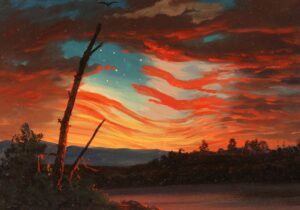
The Beautiful: country, the localities and expressions of those localities in sounds and images.
The degree to which a person, place, or idea is an expression of the good, the true and the beautiful in America can rightly be termed as part of the American mythos.
But what of America’s sins? What of our tragedies? Do they have no place in the American mythos? Of course they do. All great stories must have their tragic elements. It’s how we understand them that makes the difference.
Slavery, often referred to as America’s ‘original sin,’ is a case in point. A great evil, to be sure, but one whose eventual abolition refined and deepened our understanding and commitment to the creed and covenant of America, and ensured that creed and covenant covered the whole of the country. Additionally, the poetry, literature and music of slavery embodied the cry for freedom so central to the American creed as to make it impossible to ignore from Phillis Wheatley to Martin Luther King Jr. Slavery embodied a lie about humanity that was antithetical to the American creed, and its mere presence in a country endeavoring to enact a covenant based on that creed forced a reckoning that in many ways renewed the republic in the Machiavellian sense Simms suggests. Indeed, Harry Jaffa makes just such an argument in his Crisis of the House Divided about Lincoln’s rehabilitation of the Declaration of Independence as the American creed and the moral force behind the Union cause.
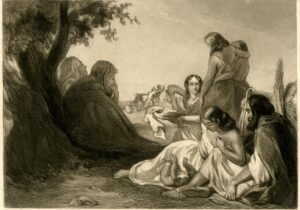
Another important case of tragedy as part of the American mythos: America’s deeply checkered interactions with the Indian tribes of the continent. Critically, the numerous Indian Wars and legal battles with various tribes throughout American history occurred specifically at the intersection of creed, covenant, and country. What one cannot escape in reading this part of American history is the acknowledged respect many, if not most, Americans had for the Indians’ relationship with the land and the skill that relationship created in terms of agriculture, woodcraft, practical natural science, and land navigation. Even the fiercest leaders of Indian resistance to American expansion (often illegal) into Indian territory hold a hallowed place among America’s heroes for their commitment to their creeds, covenants, and countries, especially in the face of broken covenants with Americans. There’s an honor and nobility there that bears witness against injustice. That, too, is rightly part of the American mythos and is why figures like Sitting Bull, Chief Joseph, and Geronimo loom large in the American story and imagination.
Of course, debate naturally arises over just what makes up the American mythos. What blend of people, places, and ideas are we to memorialize and celebrate this summer? That is where the idea of an American canon emerges.
What is the American canon? Were it just creed and covenant, I think we would be mainly focused on people and ideas, but because I’ve added country to the mix, I think we necessarily have to add places and objects to the canon as well. People, places, ideas. What people make up the American “Hall of Heroes” who embody our creed, live out our covenant, and defend our country? What places illustrate the beauty and vitality of our country? What writings, images and sounds, even foods, best encapsulate the creed, covenant, and country that make “America the Beautiful”? When it comes to educating and catechizing citizens in creed, covenant and country, the method is mythos, and the vehicle is a canon.
I can think of few better ways to celebrate America’s 250th anniversary than to rediscover the American mythos of creed, covenant and country; and explore, perhaps even define for the first time, the canon that preserves it.