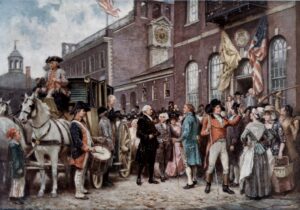

Three days before the U.S. Constitution was ratified, George Washington penned the following prediction to his friend and former comrade-in-arms, the Marquis de Lafayette:
“I expect, that many blessings will be attributed to our new government… when every one (under his own vine and fig-tree) shall begin to taste the fruits of freedom—then all these blessings (for all these blessings will come) will be referred to the fostering influence of the new government (emphasis added).”
For Washington and the members of America’s founding generation, the Biblical image of the vine and fig tree represented the ideal political order—a paradigm of good governance and civic vitality that they hoped to emulate in their own political project. Stemming from multiple Old Testament Scriptures, the vine and fig tree motif evoked notions of security, tranquility, productivity, and freedom—all principal aspirations of the Founders’ classical liberal ethos.
The first fully developed articulation of the vine and fig tree theme in Scripture occurs in 1 Kings, capturing the broad peace and prosperity enjoyed by the Israelites under Solomon’s wise reign:
“The people of Judah and Israel were as numerous as the sand on the seashore; they ate, they drank and they were happy… During Solomon’s lifetime Judah and Israel, from Dan to Beersheba, lived in safety, everyone under their own vine and under their own fig tree.” (1 Kings 4:20, 25)
The ideas implicit in the felicitous arrangement described in 1 Kings aligned readily with the classical liberalism of the American Founders. These included: (1) the proper workings of the rule of law, which protected the people from threats of violence and usurpations both foreign and domestic; (2) the sanctity of individuals’ natural rights—including the right to private property—as each lived under their own vine and fig tree; and (3) the rich fertility and contentment enabled by a life of liberty.
A second major portrait of the vine and fig tree in Scripture appears in the book of Micah—written more than two centuries after the division of Israel into northern and southern polities—and depicts the idyllic conditions of a future divine kingdom:
“In the last days the mountain of the Lord’s temple will be established… He will judge between many peoples and will settle disputes for strong nations far and wide. They will beat their swords into plowshares and their spears into pruning hooks. Nation will not take up sword against nation, nor will they train for war anymore. Everyone will sit under their own vine and under their own fig tree, and no one will make them afraid, for the Lord Almighty has spoken.” (Micah 4:1a, 3-4)
In this passage, Micah emphasizes the safety and good order enjoyed under the vine and fig tree. All conflicts and disputes have been resolved. Individuals no longer suffer trespasses by their neighbors or predations by a burdensome civil authority because their God-given natural rights have been made secure. As a result, citizens enjoy freedom from fear and can attend to the productive cultivation of their own plots. More importantly, the people in Micah’s prophecy have the freedom to worship God according to the dictates of their conscience: “Many nations will come and say, ‘Come, let us go up to the mountain of the Lord, to the temple of the God of Jacob. He will teach us His ways, so that we may walk in His paths.’” (Micah 4:2). The ideals within such scenes are reflected in the Founders’ recognition of unalienable rights to life, liberty and the pursuit of happiness, including rights of conscience and religious expression.
The final invocation of the vine and fig tree metaphor in the Old Testament is delivered by the prophet Zechariah, writing during Israel’s post-exilic period, roughly five centuries after the rule of Solomon. In this reference, Zechariah explains that an essential component of the vine and fig tree arrangement is that citizens willingly share the fruits of their estate with their neighbor: “‘In that day each of you will invite your neighbor to sit under your vine and fig tree,’ declares the Lord Almighty.” (Zechariah 3:10). In other words, in the civic order of the vine and fig tree, persons are not engaged in radical autonomy or extreme individualism. Rather, citizens voluntarily share the bounty of their vine and fig tree with their families, friends and neighbors. This closely comported with the Founders’ classical liberalism, which entrusted civil society—not redistributive policies of the state—with caring for the needs of the community.
Given the above, it is no wonder that the American Founders saw in the vine and fig tree motif an inspiring depiction of the political order that they were hoping to build. George Washington was particularly fond of the theme, referencing the vine and fig tree nearly 50 times in his speeches and private correspondence. In a letter to a friend after a lifetime of public service, Washington identified himself within the peaceful refuge of the vine and fig tree narrative:
“I am now seated in the shade of my own Vine & Fig tree, and shall devote the remainder of a life—nearly worn out to such agricultural and rural amusements as will afford employment for myself, and cannot, or ought not, to give offence to any one—offering while I am on this theatre, my sincere vows that the ravages of War, and the turbulance [sic] of passions may yield their sceptres to Peace and tranquility, that the world may enjoy repose.”
Not only did Washington view his estate at Mount Vernon as a literal embodiment of the vine and fig tree metaphor, he also considered the constitutional order of the United States to be a figurative vine and fig tree for all Americans. In the aforementioned letter to Lafayette, Washington believed that the “fruits of freedom” would be enjoyed by all Americans—both present and future—thanks to the classical liberal framework of the nation’s new charter.
While Washington was perhaps the most frequent exponent of the vine and fig tree symbol among the Founders, the theme can be found among the speeches and writings of numerous others, including John Adams, Thomas Jefferson, James Madison, John Jay, and Benjamin Franklin. John Dickinson—“Penman of the Revolution” and signer of the U.S. Constitution—considered the vine and fig tree to be the paragon of perfect liberty:
“We may with reverence say, that our Creator designed men for society, because otherwise they could not be happy. They cannot be happy without freedom; nor free without security; that is, without the absence of fear… in other words, that perfect liberty better described in the Holy Scriptures, than any where else, in these expressions—‘When every man shall sit under his vine, and under his fig-tree, and none shall make him afraid.’”
In a 1776 letter addressed to George Washington, fellow Founder George Mason—author of the Virginia Declaration of Rights (basis for the eventual U.S. Bill of Rights) and signer of the U.S. Constitution—openly beckoned God to establish in America the same peace and prosperity enjoyed during Israel’s vine and fig tree days in 1 Kings. Mason longed for the security and tranquility of the vine and fig tree story, even as he remained committed to the arduous task of the War for Independence, in the hope that such blessings might one day be secured for future Americans:
“May God grant us a Return of those halcyon Days; when every Man may sit down at Ease under the Shade of his own Vine, & his own fig-tree, & enjoy the Sweets of domestic Life! Or if this is too much, may He be pleased to inspire us with Spirit & Resolution, to bear our present & future Sufferings, becoming Men determined to transmit to our Posterity, unimpair’d, the Blessings we have received from our Ancestors!”
The American Founders were deeply attracted to the Old Testament picture of the vine and fig tree, seeing within these emblems an ideal vision of human society under heaven. While acknowledging that only Providence could anoint such perfect serenity, the Founders nevertheless perceived in the vine and fig tree motif the highest aspirations of classical liberalism and sought to establish these principles in the American political project. Today’s Americans are the rich beneficiaries of these blessings. As our nation celebrates its semiquincentennial this summer, may we look to the vine and fig tree for the inspiration of our politics once more.