Today, both scholars of just war theory and experts on the nexus of religion and international relations are often asked, “What role, if any, does religion play in the strategic worldview of the Chinese Communist Party? Can we look to Buddhism, Confucianism, Taoism, folk religion, or other religio-philosophical traditions to understand President Xi Jinping and other senior Chinese leaders?”
While religion undoubtedly remain a powerful source of meaning for millions of Chinese, in 2026 the militantly atheistic communist ideology of President Xi Jinping and his administration thoroughly guides the Chinese state. Xi’s communism, better known as “Xi Jinping Thought on Socialism with Chinese Characteristics for a New Era,” is China’s official state ideology and is now enshrined into Chinese Communist Party (CCP) doctrine and China’s constitution. It represents a decisive pivot away from what was seen as excessive Westernization, religious and cultural ambiguity, and uncontrolled and corrupt laissez-faire economics under Deng Xiaoping, Jiang Zemin, and Hu Jintao from 1978 to 2012 toward a centralized, ideologically Marxist, state-controlled system. While not a religion in the traditional sense, Xi Jinping Thought represents a quasi-religious comprehensive worldview without which it is impossible to understand China’s top leadership and the Chinese Communist Party.
As the Victims of Communism Memorial Foundation observes,
“Karl Marx’s comprehensive political, economic, and social theory of ‘communism, including the ideological belief that the struggle between social classes is a fact of history and that there will eventually be a society in which there is absolute equality and no class distinctions. Marx and his co-author Friedrich Engels argued that theirs was a scientific approach that was historically inevitable and, therefore, any means, including mass violence and terror, were justified in hastening the realization of this ideal type of society.”
Chinese communism, whether that of Mao or Xi, exemplifies this.
In short, revolution and institutionalized violence are the most important mechanisms for moving ‘History’ down the road to its logical conclusion: first to socialism (authoritarian control of all things economic), and then to communism (meaning totalitarian control of all facets of society). Burn down the old order. Impose the new idealistic blueprint. Then, elites maintain a perpetual revolution, purifying (purging) anything that stands in their way.
In the Chinese case, Mao Zedong’s victory in 1949 was only the beginning. Over the next two decades he ruthlessly destroyed all of China’s traditional institutions: the “Four Olds:” old ideas, old culture, old customs, and old habits. He caused the deaths of over 60 million people through the so-called Cultural Revolution, Great Leap Forward, and other horrific, deliberately destructive policies. Mao also imposed a strict indoctrination across society through the dissemination of his Little Red Book, containing such famous ideas as all “Political power grows out of the barrel of a gun.”
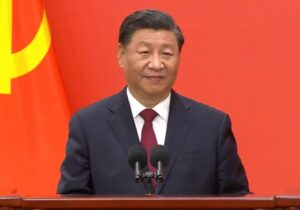
Fast forward to the rise of China’s paramount leader today, Xi Jinping. China has a complex set of CCP institutions and positions, including leadership within the party, the military, and formal political office. By 2008 Xi was vice president and by late 2012 he had effectively become China’s central national leader as general secretary of the CCP; he added the presidency a few months later.
Xi Jinping Thought on Socialism with Chinese Characteristics for a New Era
Upon becoming CCP general secretary in 2012, Xi Jinping wasted little time in reaffirming the principles of Marxist-Leninist-Maoism. In 2017, “Xi Jinping Thought on Socialism with Chinese Characteristics for a New Era,” more commonly known as “Xi Jinping Thought,” was enshrined in the CCP constitution and then into the preamble of the Chinese constitution in 2018. Rather than abandoning capitalism entirely, Xi Jinping Thought fuses heavily controlled market economics with traditional Leninist control and fervent Chinese nationalism. It is built upon four pillars: absolute CCP control, “common prosperity” and social equality, Chinese national rejuvenation, and superpower status and influence.
Here is how President Xi described it in 2013:
“First of all: Socialism with Chinese characteristics is socialism, not any other ‘ism.’ The guiding principles of scientific socialism thus cannot be abandoned. Our Party has always emphasized adherence to the basic principles of scientific socialism, but adapted to the particular conditions of China. This means that socialism with Chinese characteristics is socialism, not some other doctrine…
It was Marxism–Leninism and Mao Zedong Thought that guided the Chinese people out of the long night and established a New China, and it was socialism with Chinese characteristics that led to the rapid development of China.”
In the same address, President Xi offers the failure of the Soviet Union as a cautionary tale. He argues that the loss of its core ideology resulted in utter confusion:
“Why did the Soviet Union disintegrate? Why did the Communist Party of the Soviet Union fall from power? An important reason was that the struggle in the field of ideology was extremely intense, completely negating the history of the Soviet Union, negating the history of the Communist Party of the Soviet Union, negating Lenin, negating Stalin, creating historical nihilism and confused thinking. Party organs at all levels had lost their functions, the military was no longer under Party leadership. In the end, the Communist Party of the Soviet Union, a great party, was scattered, the Soviet Union, a great socialist country, disintegrated. This is a cautionary tale!”
Thus, China must double-down on the ideology of Chinese communism (“Socialism with Chinese characteristics”) under the iron fist of the CCP to avoid the fate of the Soviet Union.
Xi Jinping Thought on Strengthening the Military
Like any government founded on coercive control of its own people combined with a threatening posture toward its neighbors, it is crucial that the CCP exert complete ideological control over its military and other security forces. Note President Xi offered his so-called “11 Clarifications for Strengthening the Military” (in 2017, updated in 2022), to include:
-The absolute leadership of the Party over the people’s army is the foundation of the people’s army and the soul of strengthening the army.
-A strong country must have a strong army.
-The Party’s goal of strengthening the army in the new era is to build a people’s army that obeys the Party’s command, can win battles, and has a good style of work.
-The army must be prepared for war.
-In order to promote the cause of strengthening the military, we must adhere to the principles of building the military through politics, strengthening the military through reform, science and technology and talent, and governing the military according to law.
-Ruling the army by law is the basic way for our party to build and govern the army.
-Military-civil fusion is a move to rejuvenate the country and strengthen the army.
The ideological mindset is inculcated throughout the officer corps. It is trained and observed by political officers. The People’s Liberation Army’s (PLA) officer handbook says the following about the requirements for officers and how they are to be appraised. Note that ideology enforcers (“leading cadres and political departments”) will “appraise officers.”
Chapter II Basic Requirements for Officers and Their Sources and Training
Article 8 Officers shall meet the following basic requirements:
(1) being loyal to the motherland and to the Communist Party of China, cherishing firm revolutionary ideals and conviction, serving the people wholeheartedly, and devoting themselves to the cause of national defense;
Chapter III Appraisal of Officers and Their Appointment and Removal
Article 11 Leading cadres and political departments at various levels shall, in line with their division of responsibilities, appraise officers governed by them.
Chinese Strategic Worldview vs. U.S. Strategic Worldview
While U.S. military doctrine is rooted in classical just war reasoning, including jus ad bellum principles (authority, just cause, right intention) and jus in bello categories (proportionality and distinction) which constitute the backbone of the Uniform Code of Military Justice (UCMJ) and international law (e.g., Hague and Geneva Conventions), China’s strategic ethic blends Marxist-Leninist pragmatic realism and chauvinistic Chinese nationalism. We can summarize this Chinese strategic worldview in four elements.
First, Xi Jinping Thought calls for “National Rejuvenation” and always prioritizes political survival, at home and abroad. Violence and military force are functional instruments of the Chinese Communist Party (CCP) used to achieve state goals (e.g., Tibet, Uyghurs), defend core national interests (e.g., claims on Taiwan), and ensure the party’s monopoly on power.
Second, Xi Jinping Thought emphasizes the CCP’s absolute authority over the military (“the Party commands the gun”). ‘Legitimate authority’ is not defined in terms of consent of the governed or the pursuit of common good approaches to justice and security enshrined in international law. Instead, the CCP uses the security apparatus for control at home, intimidation abroad, and selectively chooses to reject Western “interpretations” of international law if they conflict with Chinese claims to national sovereignty.
Third, Xi Jinping Thought claims to be a “holistic” national security agenda. It is typically a pragmatic form of national security realism. The “justification” for this is viewed through the lens of historical grievances and anti-imperialism. For instance, military action regarding Taiwan is framed not as an aggressive war, but as an internal policing matter to end an unfinished civil war and correct historical humiliation.
Fourth, Xi Jinping Thought defends “Unrestricted” and “Intelligentized” warfare. Xi’s doctrine prioritizes cyber warfare, cognitive warfare, psychological operations, disinformation operations, economic coercion, diplomatic bullying, and grey zone operations alongside kinetic action. Under China’s civil-military fusion strategy, the line between civilian infrastructure and military capability is intentionally blurred. The successor to Mao’s revolutionary approach, China today employs a comprehensive approach to destabilization and influence operations, from omnipresent cyber probing to purchasing land near U.S. military bases to industrial espionage to TikTok disinformation operations.
This short essay is not meant to be comprehensive: it does not take into account all of the dynamics of Chinese history, society, and the current strategic landscape. What it does contribute is the important reminder that the West must not ignore the ideological convictions that animate President Xi and those around him.
Some in the West would prefer to believe that today’s CCP is captured by a form of state-controlled crony capitalism, that rising standards of living will inevitably lead China to liberal democracy, that Beijing is merely a pragmatic bully focused on limited regional influence, that the old, semi-isolationist China still exists and is internally ordered by a benign Confucianism, or even that China has entered a post-ideological era. All of these beliefs are gravely mistaken and contributed to the myopia that completely failed to foresee China’s transition to an explicit, implacable challenger to the U.S.-led world order with the accession of Xi Jinping (or earlier). Looking ahead, it is imperative that the United States’s civilian and military leadership recognize the ideological precepts from which the Chinese operate and how they radically diverge from the liberal democratic norms we in America take for granted.