When a nation believes history has chosen it to lead, restraint can begin to look like betrayal. That danger gives the Sino-American rivalry a dimension beyond the competition for markets, technology, and military advantage. Graham Allison’s Thucydides Trap illuminates the risk of war when a rising power challenges an established one. The contest also involves rival understandings of national purpose: China’s narrative of civilizational restoration and historical destiny, and America’s tradition of exceptional calling, in which national promise has long stood in tension with moral obligation.
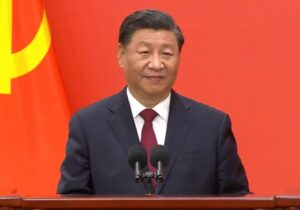
Under Xi Jinping, the Chinese Communist Party (CCP) combines Marxist-Leninist doctrine with a civilizational narrative of “national rejuvenation.” This narrative invites a limited comparison with the classical Tianming, or Mandate of Heaven, which made political legitimacy conditional on virtuous rule and therefore revocable. The Party does not ground its authority in a mandate from Heaven. Instead, it presents order, national recovery, and historic achievement as evidence of its right to rule. The parallel lies in how political authority is justified through a larger account of order and purpose. In this reading, the Party’s narrative functions as a form of political theology, expressed in the secular language of historical destiny.
Xi introduced the formulation of “profound changes unseen in a century” (百年未有之大变局) at a December 28, 2017 meeting of China’s diplomatic envoys and sharpened it at the June 2018 Central Conference on Work Relating to Foreign Affairs, where he described China as enjoying its best period of development since modern times even as the world entered a period of historic upheaval. Party discourse later condensed this outlook into Dongsheng Xijiang—“the East is rising and the West declining.” Yet the formulation is both confident and cautious: official commentary acknowledges that the West retains the stronger overall position, even as the long-term trend appears to favor the East. This is less a prophecy of imminent American collapse than a narrative of historical destiny: the West’s continuing advantages coexist, in Beijing’s telling, with China’s national rejuvenation proceeding on an “irreversible” historical course (不可逆转).
That confidence in the long term carries an immediate imperative: Beijing must act to shape the transition. By the Twentieth Party Congress in 2022, Xi’s report described those century-scale changes as “accelerating” (加速演进). On August 19, 2026, in Seoul, Foreign Minister Wang Yi told South Korean Foreign Minister Cho Hyun that these global changes were accelerating, according to the Chinese Foreign Ministry’s readout. He urged Seoul to pursue its foreign relations independently, guided by its fundamental interests, while allowing its various relationships to develop without conflict. Addressed to a U.S. treaty ally, the appeal can be read as an attempt to translate a narrative of historical momentum into influence over Seoul’s strategic choices.
China’s trajectory is contested, and the debate matters. A 2025 study in International Security portrays Beijing as a status quo power primarily concerned with regime security and limited aims. A competing analysis warns that a peaking power can become more dangerous as its window narrows. These interpretations need not contradict one another: confidence in ultimate victory can coexist with anxiety about demography, debt, technology, and encirclement. That combination is especially consequential over Taiwan, which Xi has explicitly tied to national rejuvenation.
In contrast, for decades American policy toward China rested on a very different interpretation of historical inevitability. In a March 8, 2000 speech at Johns Hopkins SAIS, President Bill Clinton argued that WTO membership would oblige China to import “one of democracy’s most cherished values—economic freedom.” Integration did deepen commerce, but it also enriched an authoritarian one-party state, accelerated its technological capacity, and supported a significant increase in China’s already high levels of surveillance—particularly over religious minorities. The 2021 Measures for the Administration of Religious Clergy require clergy to “support CCP leadership” (拥护中国共产党的领导) and the sinicization of religion. The Party did not build a church; instead, it sought to prevent any independent religious body from becoming a rival source of authority.
The American mirror is less flattering than Washington often admits. One influential strand of American exceptionalism draws on John Winthrop’s 1630 sermon, which warned that the Massachusetts Bay Colony would be watched “as a city upon a hill” (Matthew 5:14) and would be disgraced if it broke covenant with God. Ronald Reagan’s January 11, 1989 farewell address recast the image as a “shining city upon a hill.” Between Winthrop’s warning and Reagan’s radiant description lies a central tension: exceptionalism can entail increased scrutiny because America has more to live up to, or a presumption of innocence on America’s part which applies to no other nation.
Christian realism begins with that distinction. In The Irony of American History (1952), Reinhold Niebuhr challenged American innocence—the habit of clothing national interest in universal virtue while overlooking the will to power within national purpose. His insight applies on both sides of the Pacific. Beijing’s historical confidence can disguise coercion as restoration; Washington’s procedural confidence can disguise preference as universal law. A state that cannot name its own temptations will mistake self-regard for moral clarity.
Donald Trump’s first term broke an exhausted consensus about China. The December 18, 2017 National Security Strategy called China and Russia “revisionist powers”; the January 2018 National Defense Strategy described China as a “strategic competitor” and made interstate competition the principal defense concern. The reassessment outlived his first administration: the 2022 National Security Strategy under the Biden administration called China the only competitor with both the intent and growing capacity to reshape the international order. The shift, codified under Trump and sustained under Biden, was consequential and bipartisan.
Building on that reassessment requires a sustained articulation of American purpose. Tariffs, export controls, and military pressure can impose costs, but cannot on their own supply a durable account of what American power is for. At the May 2026 Beijing summit, Xi promoted “constructive strategic stability” while Trump emphasized immediate commercial gains. The contrast highlighted how an American emphasis on immediate diplomatic gains can leave Beijing greater room to claim the language of long-term stability and responsibility in international relations, even as it seeks to reshape the existing rules-based order in its favor.
A Christian realist strategy would therefore combine the pursuit of sufficient power to deter China with the restraint that comes with recognizing that the United States is not immune from national egoism and the pursuit of power for its own sake. It would pursue deterrence, resilient alliances, and industrial capacity, but also the liberal and democratic institutions which work to resist turning American leadership into a rival religion. The covenantal tradition matters politically not because Washington should impose theology, but because it places moral authority above any particular nation or government: power is held in trust, success does not prove righteousness, and no country is exempt from corruption. Such restraint allows allies to cooperate with American power without requiring them to affirm American infallibility.
The rivalry is thus a contest over more than primacy. Beijing has built legitimacy around a disciplined account of national restoration and historical direction. Washington increasingly offers transactionalism without an equally compelling account of obligation. The answer is neither disinterested complacency nor sanctified nationalism, but moral seriousness joined to strategic endurance. The city on a hill is not a certificate of innocence. It is a warning that power is visible, accountable, and always capable of betrayal.